On December 7, 2025, I ran the California International Marathon in 2:59:42. It was my seventh standalone marathon, my first under three hours, and a four-minute personal best on the 3:04 I had run in August.
I started this block with a weekly training log and stopped after week 1. Looking at the twelve weeks as a whole turned out to be more useful: what went wrong in the middle and what I did about it. The race itself is in the CIM 2025 race recap.
Why this block looked different
In August I was on track for sub-3 and faded over the last six miles. I put that down to a lack of proper long runs and durability. So this block was about durability: proper long runs, so I’d still be strong over those last six miles.
There was a second goal behind it. Sub-3 was the target for CIM, but what I care about long term is building endurance and climbing the endurance ladder. A block that only chased a time and left me broken wasn’t what I wanted.
The plan
I had guidance from Alan Couzens, and I adapted his program to my own time and schedule. A typical week had:
- Two quality sessions, usually threshold work: cruise intervals (4 × 1600 m), mixed sets of 800, 400 and 200 m at marathon, half-marathon and 10K effort, half Yassos (13 × 400 m), race-pace pick-ups and fartleks.
- A long run on the weekend, the key workout of the week.
- Easy running in between, a lot of it pushing a stroller or fitted around school drop-offs and pick-ups.
- Strength in the gym, and short hill repeats added to easy runs.
- Cross-training on the bike, plus pickleball and plenty of walking with the kids.
Here is what the running looked like week by week:
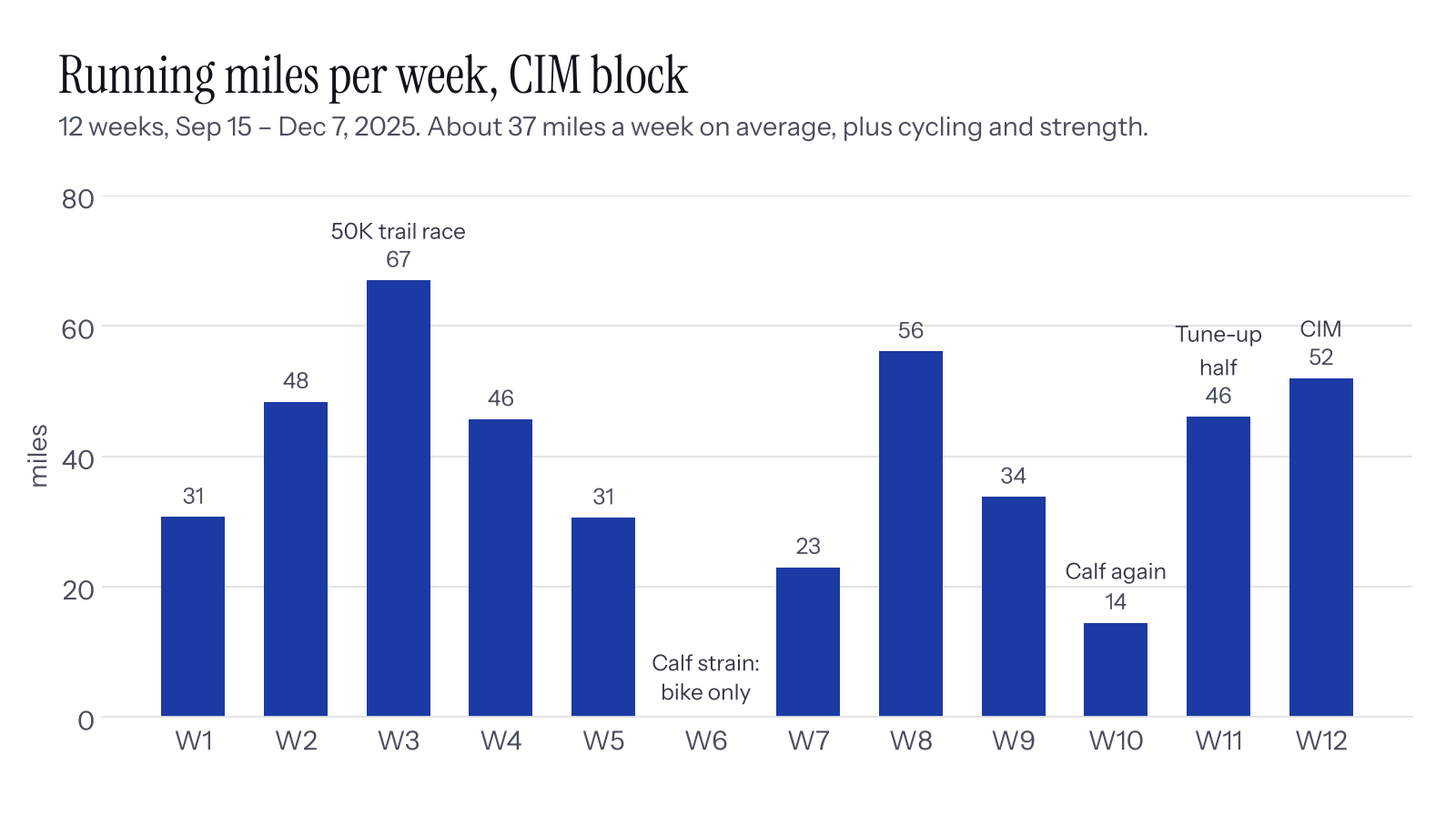
That averages out at about 37 running miles a week. It isn’t a high-mileage plan, and two of those weeks barely had any running at all.
A 50K in the middle of a marathon block
In week 3 I ran the Bull Mountain Epic, my first ultra and my first real run in the mountains. The 50K turned into 56 km (35 miles). I fought the mountain and it almost won: the second loop was technical, my ankles kept rolling, and I got a good beating.
I did it deliberately, and against Alan’s advice. Durability and endurance were the whole point of the block.
A week later I did a 14-mile long run in Asheville with about 1,600 ft of climbing, and was charged by a black bear on the way up Sunset Mountain. I yelled and roared at it, and it stopped. I still can’t believe that worked.
The calf strain, and what I’d change
In week 5 I ran the Atlanta 10 Miler as a training race. The plan was to stay between marathon and half-marathon pace and not go faster. I felt really good, pushed too hard in the last mile, and my right leg started hurting from the calf up to the glute.
That’s the one thing I’d change about the whole block: stick to the plan in a training race.
The recovery plan was two weeks of cross-training, walks included, and then slowly bringing back walk-runs. Week 6 had no running at all; I rode the bike instead. In week 7 I went back to easy running and kept the pace slow. It went well.
Downsize, don’t skip
Week 8 called for a marathon test: 26 km at marathon pace. Little sleep, heat and humidity made it a different day. Halfway through, I switched to a tempo workout, 10 km on with 1 km off, then 3 × 2 miles with three minutes of rest.
When a session doesn’t fit the day, I’d rather shorten or change it than skip it, and that’s how I coach too.
The calf came back in week 9, and I cut a long run short when it started hurting. Week 10 was mostly cross-training, with only 14 miles of running.
Fueling and gut training
I took gels on any run over an hour and on any run with intensity in it. On race day that meant about 90 g of carbs per hour, mostly Amacx gels.
The Thanksgiving Half, ten days before CIM, was the dress rehearsal for nutrition and gear. I kept it controlled, under threshold, for 12 miles and pushed the last mile to see how the legs responded. I finished in 1:33:36 and was happy with how it felt.
A one-week taper
I only tapered for one week. Race week was a few easy 5-milers with strides, then on Thursday 3 × 1500 m at race pace to dial in the effort. The first interval felt like the pace I could hold for two thirds of the race. The second and third felt too hard to sustain for a marathon. I left the workout feeling rested and ready. On Saturday, in Sacramento, I did 8 × 1 minute pick-ups at race pace.
What I take from it
Looking back, the long runs and the 50K did more than extra miles would have. I averaged about 37 miles a week, lost most of two weeks to the calf, and still ran sub-3. When I couldn’t run I rode, and the fitness was still there when the calf came back. And the plan had to fit around stroller runs, school pick-ups and short mornings, so workouts moved, shrank and changed, and the block still worked.
That’s how I build plans for the runners I coach: prescribed by time, with mileage as a guide, so an easy run can become a ride when it needs to, and the long run stays the key session of the week.
If you’re racing CIM this year, the CIM race guide has the course mile by mile, my notes from race day and a pace calculator for your goal time. If you want paces for your own training, the free training pace calculator sets them from a recent race.
Curious what a customized program would look like for your goals? Let’s talk. Reach out here, and we’ll build the next chapter together.