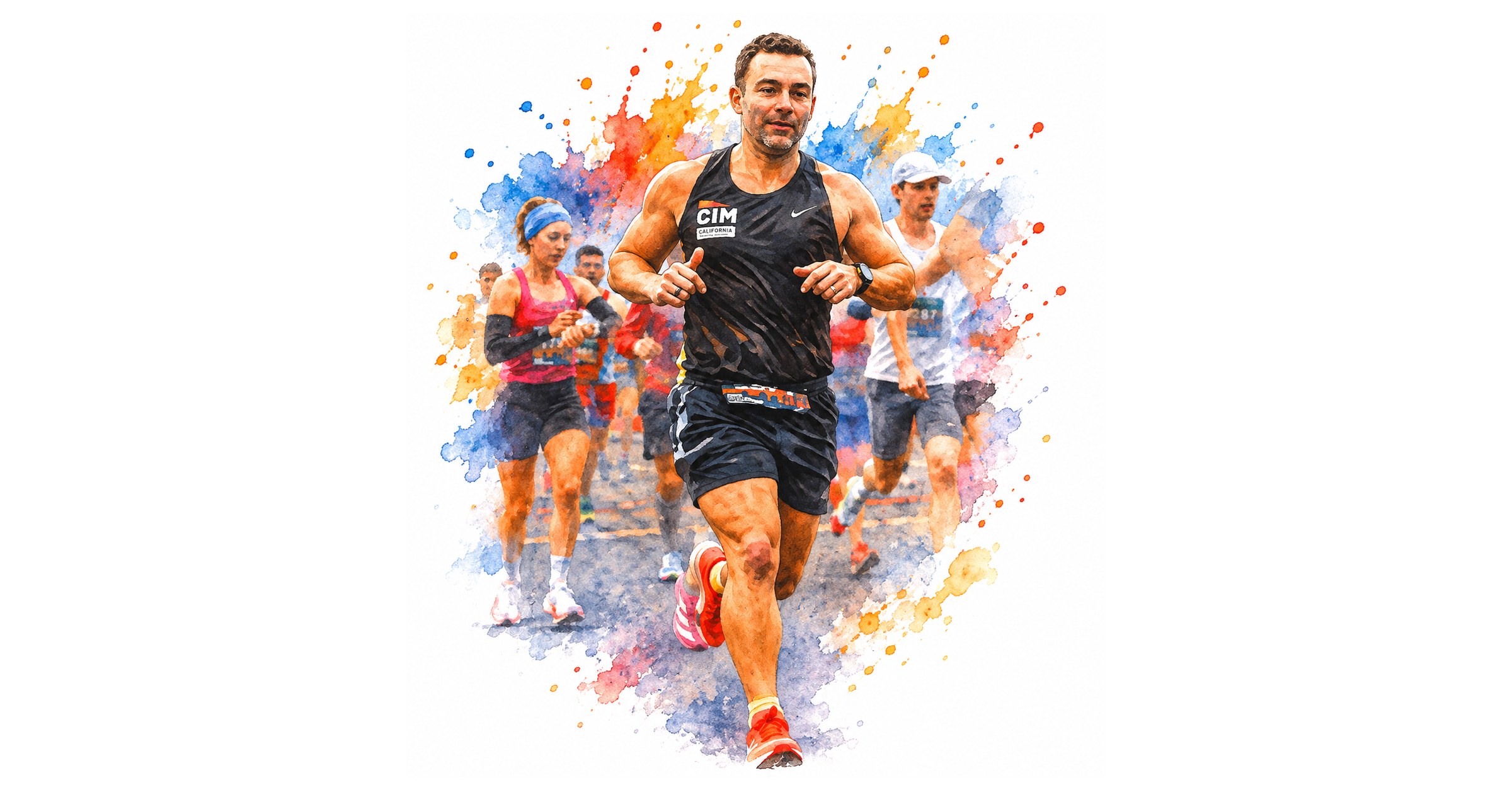
On December 7, 2025, I ran the California International Marathon in 2:59:42. Eighteen seconds under three hours, a four-minute personal best, and my first sub-3.
How I got there, including a 50K in the middle of the block and a calf strain near the end, is in a separate post: How I trained for a sub-3 marathon.
Race morning
The buses from Sacramento to the start in Folsom were really well organized. My advice: stay on the bus as long as you can. It keeps you warm on a December morning, and it was a cold, foggy one.
Miles 1–6: don’t take the downhill
The first mile is downhill, and seeing thousands of runners ahead of you going faster is impressive. I didn’t push it. I ran the first mile slower than planned and then settled in with the 3-hour pacers, who were running a little under 3-hour pace.
Miles 6–13: settling in
Through Fair Oaks we settled in, running 30 to 60 seconds ahead of 3-hour pace. I went through halfway in 1:29:19.
Miles 13–20: the quiet part
The most uneventful part of the race. I found a good rhythm and focused on nutrition: Amacx gels, which are light and easy to digest because they’re more liquid than most, at about 90 g of carbs per hour, plus a caffeine gel around mile 18.
Miles 20–26.2: hanging on
There was little left. Stomach cramps at mile 20, my quads started to hurt at 23, and everything was asking me to slow down in the last two miles. I held on for dear life 10 to 20 meters behind the 3-hour pacers and hoped the time would come in under three hours.
Don’t be misled by how even the splits look. It was a mental battle to stay with the pacers and ignore how my body was complaining.
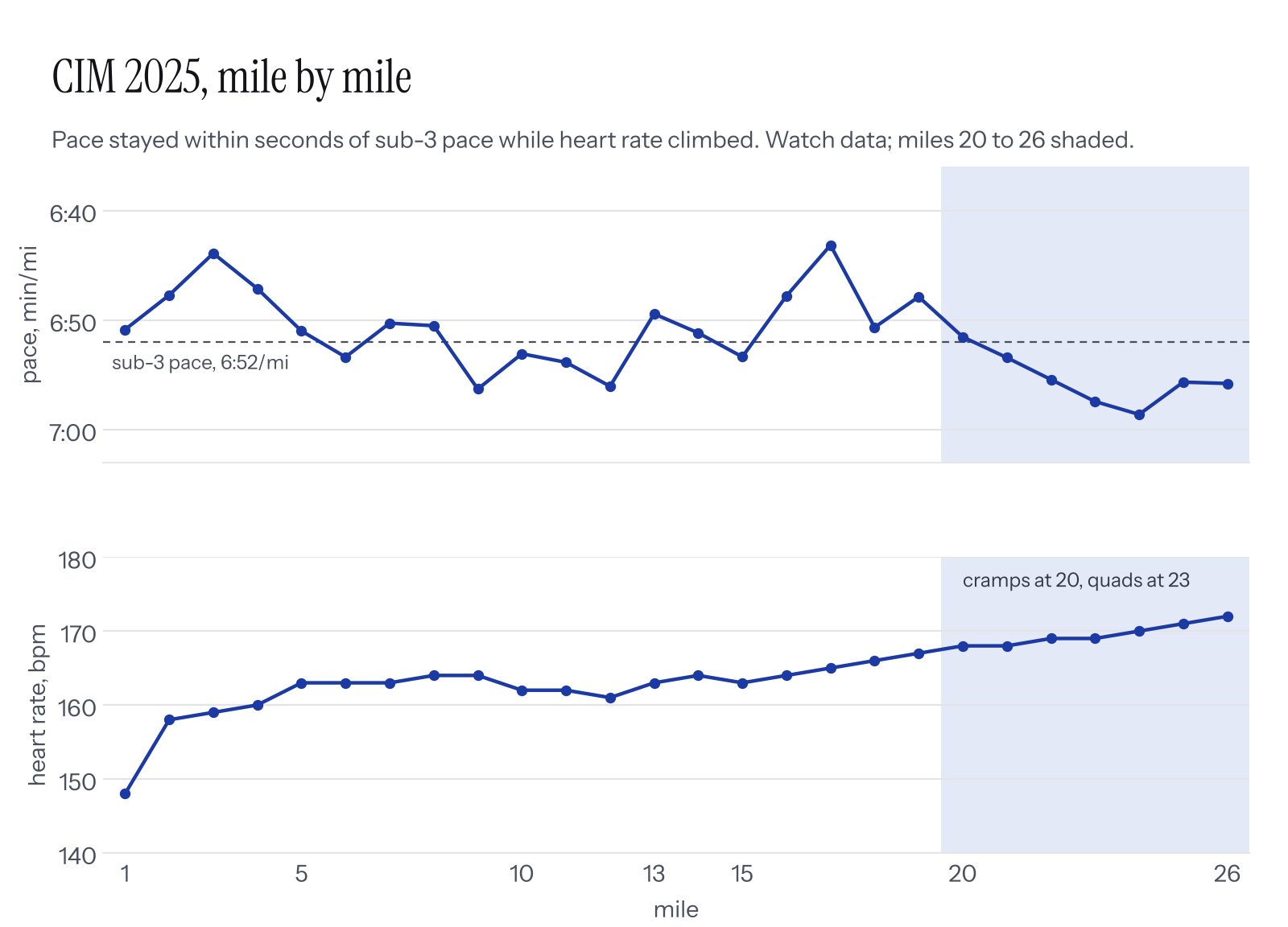
In the chart, pace barely moves while heart rate climbs the whole way, from about 150 in the first mile to over 170 in the last.
I crossed the line in 2:59:42, freaking happy, and with a holiday season ahead to just relax.
The plan that got me there
My plan was to ignore the rollers as much as possible and stick to my race pace. The terrain worked for me: the first 20 miles are easier thanks to the net downhill, and whatever I had left I used to hold that pace over the flatter last six.
For fueling, I did a typical carb load before the race: pasta, bread and a good balance of protein. Before the start I took bicarb, Nomio and CurraNZ, and a caffeine gel right before the gun.
Is CIM as fast as its reputation?
Yes. The net downhill helps, but what made it fast was the field and the pacers. I was impressed by how many runners were chasing sub-3.
One thing for your supporters: it’s a strict point-to-point race, so it’s hard for anyone to see you in more than one spot.
Racing CIM this year?
The CIM race guide has the elevation profile, my notes on each part of the course and a pace calculator that turns your goal time into mile splits for this course.
Chasing your own sub-3? Let’s talk. Reach out here, and we’ll build the plan together.