Hello, this is Eduardo and I’m an Engineering Leader and Certified Running coach. Leadership Endurance is a newsletter about leadership, endurance sports, performance and growth, in the confluence of these worlds.
The logistics
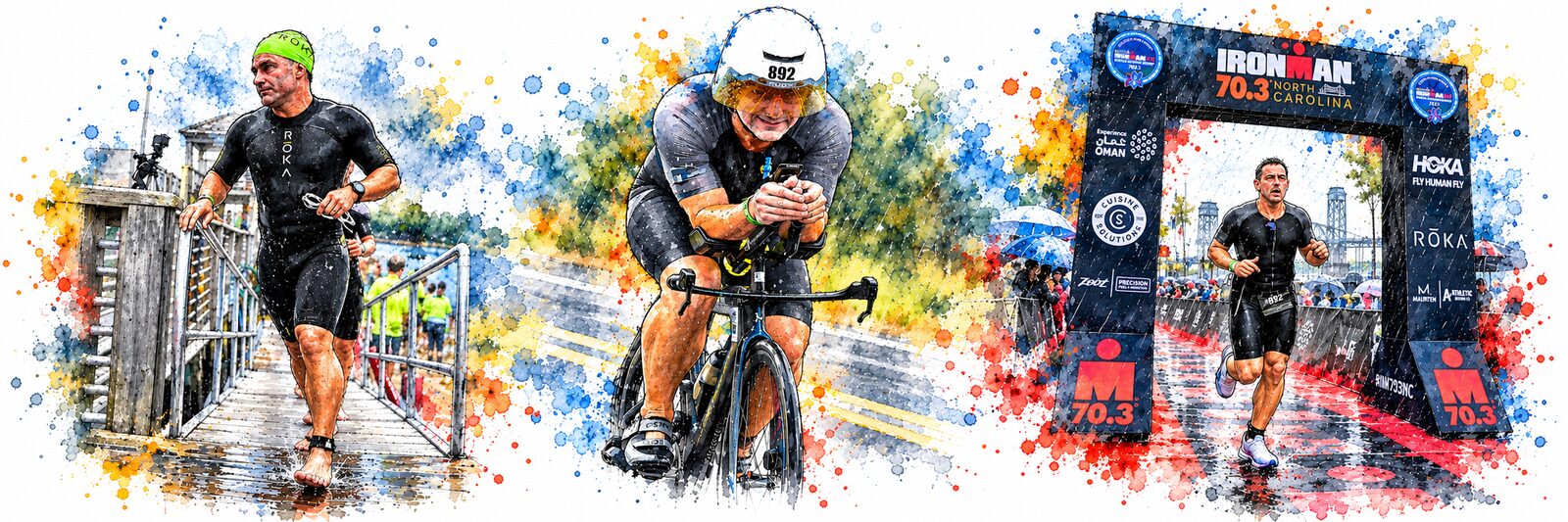
The whole family planned a week in Wrightsville Beach for the kids’ break; the weather couldn’t have been more perfect. Five straight days of beach weather entertained us and gave us a mini summer vacation in October. It set the perfect backdrop to prepare for my first half Ironman in 14 years, and my first triathlon in 4 years. And this is a distance that I loved racing before.
The goals
I went to race on October 17 with three goals; I always do this for my races, and achieving any of them is an accomplishment, with room to account for unexpected (good or bad) days. Five hours was the conservative one. 4:45 was the one that would make me genuinely happy. And 4:30 was the dream.
The dream wasn’t fantasy. It rested on the swim: based on previous years, I expected to swim 25 to 27 minutes with the current behind me. The rest of the race could build from there.
The day had other plans.
The swim
Before the start, I did what I always do: found the strongest swimmers I could and tried to stay on their feet.
I didn’t realize how rough it was until I started sighting. My watch beeps every 100 meters, and the beeps kept coming slowly. Much too slowly. The chop was heavy, and the current was nothing as I’d hoped.
So halfway through, I changed the plan. I stopped fighting the water and swam as easily as I could. I paused briefly to check I was on the right line. There was no point burning matches in a swim that was going to be slow for everyone.
I came out in 34:54, sixth in my age group. Far from 27 minutes, but on that day, a good swim.
Two small leaks
Then I made two small mistakes, back to back.
The race was wetsuit-optional, and I swam in a swimskin. I still needed help getting it off, and I ran straight past the wetsuit strippers. I had to run back. Two or three minutes gone in T1.
Then, on the flying mount, my left shoe fell off the pedal. It was clipped in too loosely. Another minute or two in the first five minutes of the bike.
Neither was a disaster. But they’re the kind of seconds you don’t get back, and on a day measured against five hours, they added up. Good lessons for training days: practice the transitions from time to time.
The bike
It rained consistently all day, but the first two hours were the hardest; I remember using my fingers as windshield wipers on my helmet because the inside of the visor would fog. The wind was worst early: you felt it most at a short turn, and then on the long highway stretch heading north, 15 to 20 miles straight into it over small rolling hills.
I had power on my head unit, but I rode mostly by feel and heart rate. The plan was to stay under 150 bpm early and let it drift down to 145, then 140. That’s exactly what happened: my average heart rate fell from about 146 in the first quarter of the ride to about 140 in the last. On the easier stretches I was holding over 180 watts; on the climbs into the wind, 240 to 250. (Recalled, not measured: the power file was lost after the race.)
I fueled well: seven 40-gram gels, about 280 grams of carbohydrate, plus around two liters of electrolyte drink. That’s over 100 grams an hour, right where I’d trained to be.
Near the end, we were all asked to walk across the last bridge because of the metal grates. Another few minutes, for everyone.
No scares, no crashes. Just a long, wet, honest ride: 2:40:54.
The run
My legs came off the bike a little like jelly, as they always do. The surprise was the ground. For the first mile or two, I ran along the boardwalk and over cobblestones slick from the rain, in the most aggressive super shoes I own, ASICS Metaspeed Ray. Managing speed on that surface took real care.
Then I found my pace, 4:30 to 4:35 per kilometer, and realized it felt comfortable.
There was no low point. It was a fight to get under five hours, and that kept me motivated the whole way. I didn’t have another gear, but I didn’t need one.
There were highlights, though. Right in the corner of T2 I saw my wife, it was hard to miss her! A runner next to me said I had an amazing crew cheering me on. It was one person.
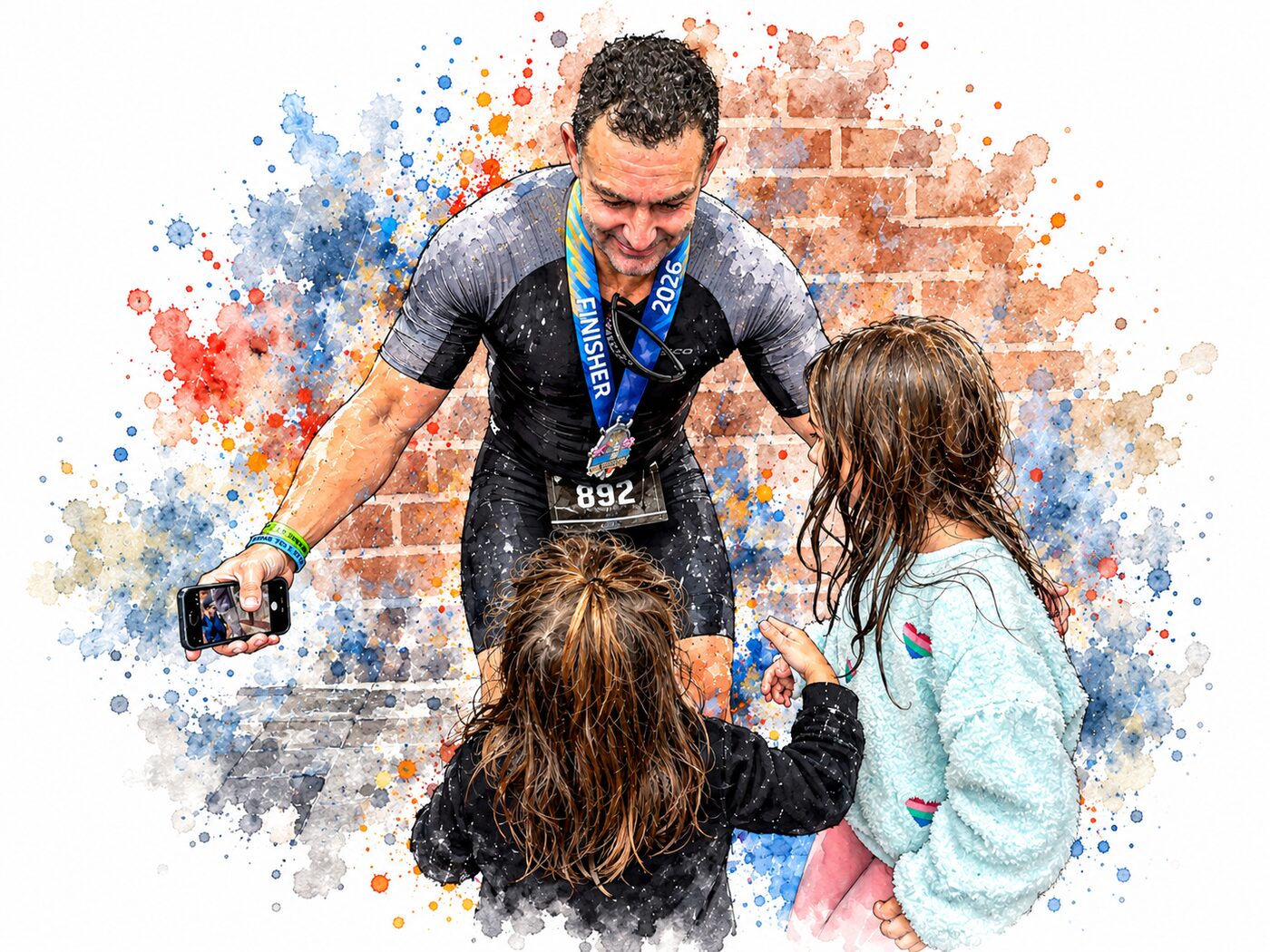
And with 500 meters to go, there they all were: my kids, my parents-in-law and my wife. I’ll keep that moment for a long time.
Run: 1:35:03. Finish: 4:59:38.
The result
I found out afterward, looking at the results, that I’d finished seventh of 149 in M45–49, and 113th of 2,438 overall.
I was really happy. Not 4:30, not 4:45, but under five hours, on a day of rough water, wind, rain and cold, with a couple of mistakes of my own. Everything else went well.
The conditions cost everyone. Third-party race data puts the 2026 median finish 26 to 29 minutes slower than 2025, and the non-finishing rate around 12%, up from about 2% the year before.
The median overstates it for athletes near the front, who tend to lose less on a hard day. A tighter comparison: seven athletes who finished top 10 in their age group in 2026 and also raced in 2025 were a median of about 13 minutes slower this year. Take that off my 4:59:38 and you land around 4:47. That’s an illustration, not a corrected time, but it says the 4:45 I’d have been happy with was within reach on a normal day, and the dream wasn’t far behind it.
Two places short
I went to the awards ceremony. World Championship slots go first to each age-group winner; the rest are awarded on an age-graded performance ranking, with men and women ranked separately. I finished 48th in the men’s ranking, with an age-graded time of 4:30:16. As I remember it from the ceremony, the slots ran out at 46th.
Two places. In age-graded time, 46th finished 36 seconds ahead of me, which works out to about 40 seconds of actual racing. Less time than I lost running back to the wetsuit strippers.
I didn’t leave disappointed. I left seeing how close I was, and knowing exactly where to look next. My swim and run were competitive in my age group. The bike, 23rd in my age group, is where the time is.
What’s next
Next September, I’m racing IRONMAN Chattanooga, a full distance, with a dream attempt at a slot for the IRONMAN World Championship in Kona. I’m documenting the whole build, with the numbers, in a monthly series: Road to Kona 2028. The first installment is coming soon.
What I’m taking back to work
A race like this compresses a lot of leadership into one morning. Four things stood out.
Set tiered goals. A single target turns the day into pass or fail. Three tiers let me commit fully to the dream without betting everything on it. When the swim took 4:30 off the table, I didn’t have to renegotiate with myself; the next goal was already waiting. I try to do the same with teams: a commitment, a target and a stretch, agreed before the work starts. A bad week then changes which goal we’re chasing, not whether we’re still trying.
Change the plan when the data changes. My watch told me, 100 meters at a time, that the swim was slow. I could have fought the water harder. Instead I accepted the signal, eased off and checked my line. The best calls I’ve seen leaders make start the same way: noticing early that the day is different from the plan, and saying it out loud instead of pushing harder on a plan that no longer fits.
Own the small mistakes. I lost minutes to two avoidable errors, and neither one was the weather’s fault. Naming them plainly, and turning them into something to practice, is what stops them from happening again. On a team, that kind of honesty from the leader gives everyone else permission to do the same.
Control what you can inside conditions you can’t. Everyone raced the same wind, rain and chop. My result came from what I did inside them: pacing by heart rate, fueling to plan, and staying motivated for a number I could still reach. Most of leadership works like that. You rarely choose the conditions; you always choose your response.
Under five hours wasn’t the goal I dreamed about. It was the best result available that day, and I’m proud I found it.
Thank you
To my wife and my family: you’re the ones who go without me every time I’m out training. This result is yours too.
Results
| Segment | Time | Rank in M45–49 |
|---|---|---|
| Swim | 34:54 | 6th |
| T1 | 5:46 | |
| Bike | 2:40:54 | 23rd |
| T2 | 3:03 | |
| Run | 1:35:03 | 9th |
| Finish | 4:59:38 | 7th of 149 |